



We gave our Gear Lovers one job:
Find the best and most popular products and review them.
Our review team always considers durability, price, quality, and value in their reviews.
Where to buy Aquaglide Cirrus Ultralight 110:
REI
The Aquaglide Cirrus Ultralight 110 is one of Aquaglide’s newest releases for spring 2023. We were excited to have the opportunity to test this ultralight touring inflatable kayak before most, especially considering the hype it’s been given.
The exciting new design of the Cirrus Ultralight 110 finds the sweet spot between durability, packability and weight, and is a dream craft for those looking to take their adventures onto the water.
Up until now, adventure seekers and backcountry explorers who want to transport themselves and their gear down rivers and across lakes have been using packrafts. Packrafts are a great lightweight and packable craft that can transport you on the water. But they offer very little tracking so it’s challenging to keep the raft straight.
Things we like:
-
 Ultralight
 -
High-performance touring kayak
-
Crazy small packability
-
Bungees and multiple D-rings for attaching gear
-
Easy to attach fin
-
Easy to set up
-
Adjustable seat and footrest
-
Comfortable and lightweight inflatable chair
-
Great maneuverability
-
Center carry handles for easy transportation
-
Center carry handles for easy transportation
Things we don't like:
-
 Pump not included
 -
Paddle not included
-
More expensive than other single inflatable kayaks
-
Drainage valve sticks out from the bottom of the hull
-
Straps on the chair are hard to adjust
Where to buy Aquaglide Cirrus Ultralight 110:
REI
- Material: TPU/70 denier nylon
- Length: 11’35″
- Width: 33”
- Tube Diameter: 9.5”
- Weight: 14.75 lbs
- Max Load: 300 lbs
- Max Passengers: 1
- Seat Type: Inflatable
- Drain Valves: 1
- Packed Dimensions: 23 x 15 x 16 inches
- Use: Touring/flatwater kayaking
Ultralight for Real!
It’s difficult to compare the Cirrus to any other inflatable kayak we’ve tested, as it’s in a class of its own. To give you some idea of how light it is, the Razor Kayak R1, which is also an inflatable touring kayak, weighs almost four pounds more before you add in the heavier fabric cushioned seat.
If you’re not wowed by this, consider the Cirrus Ultralight 110 is two full feet longer than the R1, which really puts things into perspective.
If you’re looking for a touring or expedition inflatable kayak that you can haul up to alpine lakes, travel down rivers with all your gear, and store in a closet or under your bed, the Aquaglide Cirrus Ultralight 110 is the ultimate choice for you.

A Cirrus-ly Lightweight Kayak
The Cirrus Ultralight 110 is brand new in Aquaglide’s lineup of inflatable kayaks and their lightest touring kayak ever released. It is bound to take the paddling world by storm, striking the perfect balance between performance and packability.

For backcountry explorers who want to travel further on the water, the Cirrus Ultralight is a performance touring kayak with the weight of a pack raft. This inflatable kayak is a game-changer for crossing lakes, navigating flatwater rivers, and taking adventures to the next level.
The packability of the Cirrus is mindblowing. If you’re short on storage space, you could literally fit this inflatable kayak in your closet or under your bed. Though it has the capabilities for touring and the weight for hauling long distances, if you’re looking for an ultralight kayak you can carry to the water single handed and stow away in your wardrobe, the Cirrus is a perfect candidate.

Aquaglide has thought of every feature that makes an inflatable capable of touring: bungees, mini-MOLLE plates, additional D-rings, and abundant splash-proof storage.
Exploring this kayak for the first time was exhilarating. The Cirrus checks everything off the list we would want in an ultralight inflatable touring kayak.
The Lightest Kayak is Also Durable
The technology that has gone into making the Aquaglide Cirrus Ultralight 110 includes TPU 70 denier nylon fabric providing remarkable strength and rigidity for the body of the kayak. This kayak has the strength of PVC without the additional weight.
The TPU drop-stitch floor also creates a hull that mirrors a hardshell and performs almost as well. We were surprised an ultralight kayak like this would have a drop-stitch floor, but Aquaglide has managed to maintain quality and performance without compromising on weight.
A comparable inflatable touring kayak with the rigidity of a drop stitch floor is the Razor Kayak R1, which weighs 18 lbs without the fabric seat or any other accessories compared to the 14 lbs of the Cirrus. The R1 is made with 1000 denier PVC compared to the nylon of the Cirrus, which adds to the weight of the R1.

Setting Up the Cirrus
The Cirrus Ultralight 110 was one of the easiest inflatable kayaks we’ve ever set up. The kayak doesn’t come with a pump, so you will need to purchase this separately. But the recommended PSI for the side chambers and the floor was easy to achieve without breaking a sweat and the seat took mere seconds to inflate with the mouth tubes.

Our Cirrus didn’t come with a manual, but that is almost a testament to how easy it was to set up. On the floor and side chambers, there is printed information telling you what to inflate first. The side chambers should be inflated first to a PSI of 3.0 and the floor should be inflated afterward to a PSI of 6.0.


We made the mistake of leaving the inflatable chair in the cockpit when we inflated the floor and side chambers and had to peel it out because it got trapped between both. Be sure to remove the chair before inflating the kayak and attach it afterward.

We were a little skeptical about the inflation tubes on the chair at first. But it literally took seconds to inflate the seat and backrest separately by blowing into the tubes, and we realized this is the quickest and most efficient method of doing so.


Once the chair is inflated, it needs to be squeezed back into the cockpit. It seems like the chair is too wide for the kayak, but we think Aquaglide has designed it this way so that there is no risk of the chair ever coming loose if you capsize.

Another nifty feature of the Cirrus 110 is the Velcro strips that run down the length of the cockpit. These strips allow you to secure the chair anywhere you want and make adjusting the EVA footrest quick and easy. Compared to the footrest of the Razor Kayak R1, which uses Velcro to loop around D-rings, or the Tomahawk Air-K 375, which you have to thread the webbing through a buckle to adjust, the footrest of the Cirrus 110 was the most simple.


The only part of the setup that could have been less complex was adjusting the straps on the seat. The problem is that the webbing is threaded through a buckle and looped around the ring on the end of the clip, making it hard to adjust the tension of the backrest.

We weren’t able to simply pull on the end of the strap to tighten the tension. Instead, we had to feed the webbing through the buckle manually to adjust it, which is probably our biggest complaint about the design of the seat.

To balance out our slight annoyance over the seat straps, the weedless fin is the easiest inflatable kayak fin we’ve had the pleasure to attach and remove. We wish Aqua Marina and Razor Kayaks could take a leaf out of Aquaglide’s book here. The quick release fin of the Cirrus just slides into place like a puzzle piece and locks easily into position. This basic feature is a big win in our books.

Rigidity Makes Stability
With a width of 33” and a 9.5” tube diameter, the Cirrus Ultralight 110 is incredibly stable. Even paddling this kayak without the fin, you would really have to work hard to flip this kayak over. What makes the Cirrus Ultralight 110 so stable is its rigidity. The drop-stitch floor makes the floor as rigid as a paddle board, meaning if you have good balance, you could likely stand up in this boat.

The weedless fin adds to the stability of the Cirrus and if you pack your gear well, the additional weight will add even greater stability when you’re paddling. Be careful not to overload the front or the back deck or have items that might move or shift when you paddle.
We recommend you store your heavier items in the splash proof storage areas at the bow and stern of the kayak or behind the seat. The front and back decks are perfect for storing your lighter items that need to be more accessible, like a bailing device or a sponge.
The Cirrus Ultralight 110 and Razor Kayak R1 are both the same width of 33”, but the hull of the Cirrus is flatter than the R1 because the side chambers are more rounded and sit closer to the water. The R1 also has a more defined V-shaped hull, which cuts through the water better but will cause it to be slightly less stable.

Both the Cirrus and R1 are a lot more stable than the Tomahawk Air-K 375, which is 5” narrower. But the Tomahawk is built for speed and tracking, while the Cirrus and R1 are built for touring and performance.

Light Like a Cloud
The Aquaglide Cirrus Ultralight 110 is light like a packraft, but performs like a touring kayak. Aquaglide has used state of the art technology to design an inflatable that has the ability to track and glide seamlessly through the water, while being light enough to carry over your shoulder with one hand.

The bow extrusion strip and weedless fin provide superior tracking for a single inflatable of 11 ’35”. The drop-stitch floor also contributes to its performance by creating a rigid hull that cuts through the water gracefully.
The Cirrus can’t compete with the performance of an inflatable like the Tomahawk Air-K 375, which is built with speed and tracking in mind. But it is comparable to the Razor Kayak R1, which is also designed as a touring kayak.
We found the tracking of these two inflatables very similar. The V-shaped hull of the R1 provides better tracking than the rounder hull of the Cirrus. But the two boats tracking are comparable because the Cirrus is two feet longer than the R1 and has the additional bow extrusion strip.

Regarding maneuverability, the Cirrus performs well both with the fin and without. Its touring rocker profile makes it easy to make quick, agile turns while not spinning 360 degrees like you would if you made a hard turn in a pack raft. You can’t edge the Cirrus like you can the Tomahawk when turning, but because the Cirrus is a foot shorter, the slightly shorter hull grants it better maneuverability.

Drainage: Good & Less Good
We were a little surprised by the drainage plug on the Cirrus Ultralight 110. Given the quality of the rest of the kayak, the protruding draining valve beneath the stern seemed a little out of place. The valve doesn’t create a large amount of drag and affect the speed of the kayak, but it could possibly catch on or scrape against rocks if it’s very shallow or even get weeds or long grass hooked around it.

What we do like about the draining value is it has a screw cap rather than a plug like Aqua Marina’s Betta 412 or Steam 412. These plugs are easy to open and don’t protrude beneath the kayak, but they’re also susceptible to opening by accident or not sealing securely enough.

What we also didn’t love about this drainage valve is that it’s not right at the end of the stern like the Razor Kayak R1, which allows you to drain all the water out of the boat with one tip because the water has nowhere to go other than out of the drain.

The value of the Cirrus is half a foot from the stern of the kayak, which means when you tip it vertically to drain the water out, any water that doesn’t drain gets caught in the stern of the kayak. You’ll need to repeat this process multiple times. It may be easier to simply hold the kayak above your head from the center straps and rock it back and forth if you don’t mind getting a little wet in the process.

Weight Capacity
The weight capacity of the Aquaglide Cirrus Ultralight 110 is an impressive 300 lbs, given how lightweight the kayak is. The Cirrus actually has a higher weight capacity than the Tomahawk Air-K 375, which weighs almost 22 lbs more than the Cirrus.
It’s hard to understand how the Cirrus can carry more weight than the super rigid drop-stitch construction of the Tomahawk, but if we needed to make a guess, either Aqua Marina is a little more tentative on their max load calculations, or perhaps it has more to do with the sleek and narrow design of the Tomahawk.

The Razor Kayak R1 has a slightly higher weight capacity than the Cirrus at 395 lbs, but this was to be expected as the R1 is heavier, made from PVC rather than nylon and has a heavily reinforced floor compared to the Cirrus.
Regardless of these comparisons, a 300 lbs weight capacity is sufficient for one full-sized adult and a healthy amount of gear. With the drop-stitch floor, you could travel with your K9 too, although we’d be more concerned about claws on the nylon side chambers that are more fragile than heavy-duty, reinforced PVC.
More Length
The length of the Cirrus Ultralight 110 is 11’ 35”, which provides ample leg room and storage space for a single paddler. Comparable to a single pack raft which could be anywhere from 7-10’, the Cirrus has the length to track comfortably across lakes and down flatwater rivers.
The two feet of additional length that the Cirrus has over the Razor Kayak R1 provides greater storage space for gear (more on that in a bit). The Velcro strips on the floor also mean the seat is entirely adjustable, so if you wanted lots of legroom in the Cirrus, you could achieve that by attaching the chair closer to the stern. (Just be aware this will affect the stability of the kayak).

What we found the most impressive is how well the Cirrus packs down for its size. The packed dimensions of the Cirrus are 23 x 15 x 16 inches, which is unbelievably small for a kayak of this size.

Deck and Storage
When we took the Aquaglide Cirrus Ultralight 110 out of the box for the first time, our faces lit up when we saw how much storage space there was on the front and rear deck and the quality of the bungee cords you can attach your gear to. Although we don’t recommend overloading the decks with too much gear, it’s great to have easy access to equipment like a pump or bailing device, a spare collapsible paddle, a dry bag full of snacks, sunscreen, etc.


The Razor Kayak R1 also has bungees on the front and back desk, but they aren’t quite as elaborate and secure as the Cirrus. The Tomahawk Air-K 375 doesn’t come with bungees, but that’s because the Tomahawk is designed as a performance kayak, not a touring kayak.

The other wonderful feature the Cirrus has over the R1 or the Tomahawk is the mini-MOLLE attachment system, designed to attach items like your camera, water bottle, pocket knife, torch, first aid kit, etc.

We can’t rave enough about the healthy amount of storage in the Cirrus. There is sufficient space under the splash proof bow and stern deck, as well as plenty of space behind the seat of the paddler.
Having shorter kayaks with limited space to compare to only highlights this factor as a triumph by Aquaglide’s designers.
What we love most about the storage in the Cirrus are the multiple D-rings and attachment points where you can secure your gear. You could even use the Velcro lining on the floor of the cockpit to attach gear that you need to access quickly like a map.

Carry Handles
The Cirrus Ultralight 110 has molded plastic carry handles at the bow and stern of the kayak, as well as two handles in the center of the cockpit for easy transportation by one person.

We are very glad Aquaglide didn’t try to save weight by removing the center handles as they make carrying the kayak on your own so much easier.

The handles mold to your hand and provide a non-slip grip that won’t dig into your palm or fingers, even if you’re carrying a fully-loaded boat.

The center handles are where the Cirrus excels over the Razor Kayak R1. To carry the R1 on my own, I either need to hold onto the side air chamber or the seat and footrest attachment. The Cirrus is so much easier to transport than the R1 because of these handles and also because it’s a lot lighter overall to carry.
Backpack and Storage Bag
The storage bag of the Cirrus Ultralight 110 is one of the most functional storage bags we’ve come across. The storage bag is a compressible dry sack, which means you can use it to store your gear and clothing in it during your trips, and also your kayak in it when you’re off the water.
The bag itself is big enough to store the deflated boat, plus a pump and even collapsible paddles. It doesn’t have backpack straps like the Razor Kayak R1, but because it’s designed for backcountry use, the shoulder strap is likely more convenient if you’re already wearing a backpack.

The only downside of a dry bag is that it’s slightly harder to slide the deflated kayak in and out of because the fabric of the bag and the boat get caught on each other. The other issue is the bag is non-breathable, so you’ll want to make sure the kayak is 100% dry before putting it back into the bag. Otherwise, you’ll risk mold forming.

Seat
The seat of the Cirrus Ultralight 110 was the feature that surprised us the most. At first glance it didn’t look like it would be rigid enough. Plus, once inflated, it isn’t very thick, so we questioned how comfortable it would be. We also questioned how hard and effective using a mouthpiece would be to inflate the seat as well.

Thankfully, we were pleasantly surprised on all accounts. Inflating the seat was quick and straightforward. It was also easy to close the valve once the seat was fully inflated so no air would escape.
The seat is surprisingly rigid for how lightweight it is, and with the webbing straps that attach to the D-rings on the side air chambers, you can adjust how upright you want to be. As mentioned above, one of our pet peeves about setting up the Cirrus is the adjustment of the seat straps, which don’t slide smoothly through the buckle.

Once the seat is inflated, it’s too wide for the cockpit, so you really need to squeeze the seat into place once the body of the kayak is inflated. I’m not certain if you’re meant to inflate the chair first, but just be aware it’s a bit of a tight squeeze to get the seat into position.

The seat of the Cirrus is another one of its selling points. It is one of the comfiest seats of any inflatable we’ve tested, and that’s saying a lot. I find the inflatable seat much more comfortable than the fabric seat of the Razor Kayak R1 or the Tomahawk Air-K 375. Even compared to the blowup seats of the Aqua Marina Betta 412, the Cirrus is in a class of its own regarding comfort, weight, and simplicity.

The only downside to inflated seats is they don’t have a pocket or water bottle holders in the back of them like most fabric seats. But what we love about the inflatable seat of the Cirrus is:
- it doesn’t move around when you tip the kayak upside-down like fabric seats do,
- it’s super comfortable,
- it’s adjustable in that you can blow it up more or less depending on your preference,
- you can attach it anywhere in the cockpit using the Velcro strips,
- and it’s likely the lightest kayak chair out there.

Footrest
The footrest of the Cirrus Ultralight 110 also ranks very high for us because it’s so easy to adjust, lightweight, and comfortable. The ultralight EVA design is very different compared to the Tomahawk Air-K 375, which has a heavy foam-roller style with webbing straps that attach to D-rings in the boat’s cockpit.

The Razor Kayak R1 also has an ultralight footrest design that uses Velcro, but instead of attaching the footrest to the floor, you feed the Velcro straps through D-rings and adjust the length of the straps depending on how long your legs are.

In our opinion, the footrest of the Cirrus is the most straightforward, easy to adjust, and the most functional of the three.

A Fin That’s Easy to Attach
There are so many features we loved about the Cirrus Ultralight 110, but the design of the fin made us jump for joy. This was the first fin we didn’t have to use super-human strength to slide in and out of the attachment slot or figure out how to lock it into place.

We got excited the moment we saw the puzzle piece design at the top of the fin. We didn’t immediately know how it would attach, but the shape alone told us that this is no ordinary fin.

The slot for the fin is also a lot less rigid than on most inflatable kayaks, and instead of having to slide it horizontally through the narrow slot, the fin of the Cirrus simply slips into the slot perfectly, and the locking mechanism is a simple peg in a hole contraption.

The curved design of the front of the fin is what makes it weedless. Weeds, long grass or seaweed won’t catch and cause extra drag when you’re paddling. As mentioned earlier, you can easily paddle the Cirrus without the fin if you’re traveling through very shallow water. But, for the best tracking it’s always advisable to use the fin.

Keeping the Cirrus Light & Fast
Our Cirrus Ultralight 110 did not come with a repair kit or manual, but from looking at third-party sites selling this kayak, it comes with a Halkey-Roberts Style Valve adaptor to tighten the valves in case they come loose and start releasing air from the kayak.
Unlike the Razor Kayak R1 and the Tomahawk Air-K 375, which come with PVC patches, the Cirrus is made from nylon, so it’s a lot more difficult to repair. This may be why you might not want to take your favorite K9 in this kayak. It’s also a valid reason why this kayak is designed for backcountry touring rather than heavy backyard use by the kids.
As with all inflatable kayaks, it’s important not to store the Cirrus in direct sunlight where it can be damaged by UV light. It’s also important to ensure the kayak is completely dry in all creases before you store it away, especially inside a waterproof bag.

If you are going to keep the Cirrus inflated between uses, we would recommend deflating it a little so that you don’t risk the air expanding in the heat. You should also periodically check the kayak for leaks by leaving it inflated overnight before using it the next morning to test the air pressure.
Do we recommend it?
One word: absolutely! Aquaglide’s Cirrus Ultralight 110 is an extremely impressive lightweight touring kayak with high performance capabilities. It is built with state of the art technology to maintain its functionality while being one of the lightest inflatable kayaks on the market.
The Cirrus Ultralight is a pack rafter’s dream. You could easily take this kayak into the backcountry along with the rest of your expedition gear and paddle it comfortably across lakes and down flatwater rivers. At just over 14 lbs, you also don’t need to break your back while doing so.
The Cirrus was built to store gear with multiple attachment points and bungees to ensure your possessions are safe and secure. The Cirrus is also customizable and adjustable, meaning you can place the seat, footrest, and your gear almost anywhere you like in the boat.

This kayak is not designed for heavy use by young kids on your cabin lake. Although it is stable enough for the kids, this kayak is built to be ultralight with 70 denier nylon rather than PVC, which weighs a lot more. This is not a rough-and-tumble sort of inflatable kayak. It’s designed to be carried and paddled long distances along with your other backcountry gear.
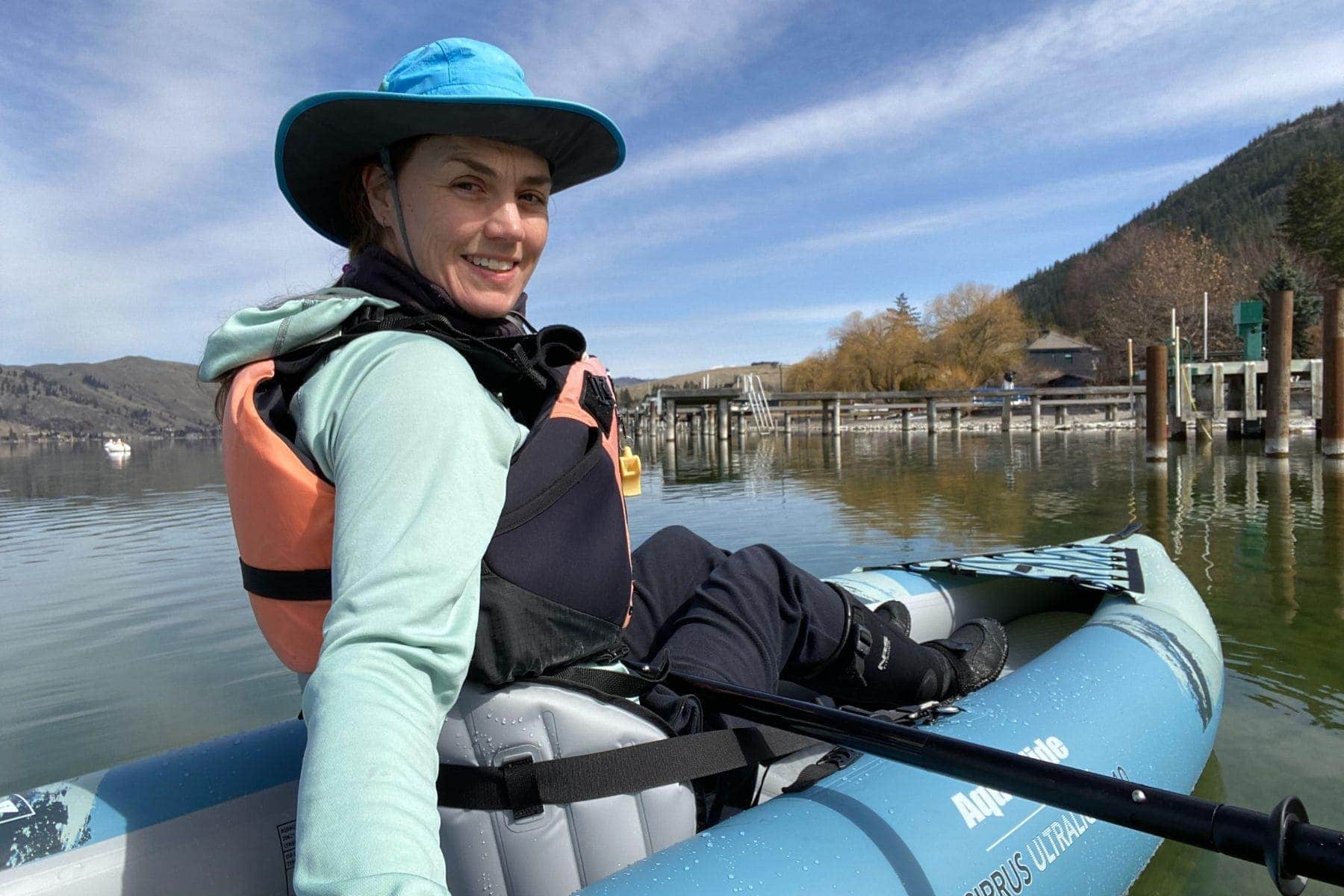
If you have a bit of extra money and want the most packable inflatable kayak on the market then the Cirrus is a fantastic option. The Cirrus is a specialized inflatable kayak built for adventurers who want a kayak rather than a pack raft, so they can take their adventures to the next level.
Features
- TPU (Thermoplastic Polyurethane) 70 denier nylon fabric is lightweight yet robust and rigid
- TPU Ultralight Drop-Stitch floor provides the rigidity of a paddleboard with the weight of a pack raft
- Comfortable, ultralight inflatable seat
- Easy to adjust, EVA (ethylene vinyl acetate) footrest
- Easy to attach weedless fin for improved tracking
- Molded plastic carry handles on the bow, stern and center of the kayak for easy transportation
- Multiple D-rings behind seat and in stowage areas to attach gear
- Deck cargo bungees to safely store gear for easy access
- Cockpit drainage value in the stern of the kayak
- Compressible dry storage bag can be used for clothing and gear
- Mini-MOLLE (Modular Lightweight Load-carrying Equipment) Attachment System beside seat to store easy to access items
- Velcro strips allow for customized seat and footrest positioning
- Halkey-Roberts valves for easy inflation and deflation
Accessories:
- Waterproof, compressible storage bag
- Quick-release weedless fin
- Adjustable EVA footrest
- Detachable inflatable seat
Related Reviews


Things we like:
-
Ultralight
-
High-performance touring kayak
-
Crazy small packability
-
Bungees and multiple D-rings for attaching gear
-
Easy to attach fin
-
Easy to set up
-
Adjustable seat and footrest
-
Comfortable and lightweight inflatable chair
-
Great maneuverability
-
Center carry handles for easy transportation
-
Center carry handles for easy transportation
Things we don't like:
-
Pump not included
-
Paddle not included
-
More expensive than other single inflatable kayaks
-
Drainage valve sticks out from the bottom of the hull
-
Straps on the chair are hard to adjust


 Back
Back



Comments